
A par level is the minimum quantity of each item you want on hand before reordering — set high enough to cover usage until the next delivery plus a safety buffer. A classic rule of thumb: par = (daily usage × days between deliveries) × 1.5. Items that run out between deliveries cost you sales; items you over-order tie up cash and rot on the shelf. Par levels are the single cheapest form of stock control that exists.
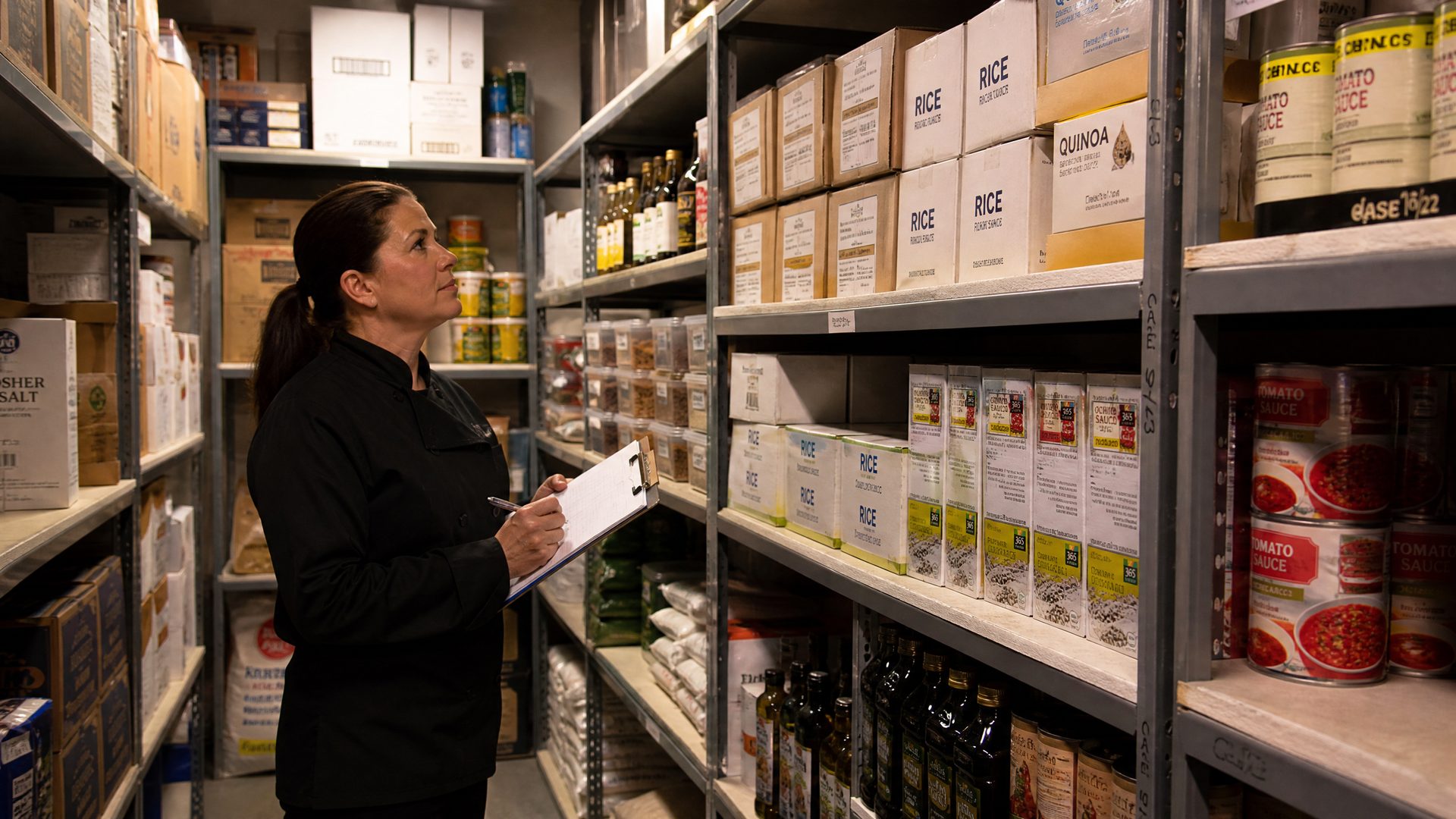
A par level is simply the answer to one question: what is the smallest amount of this item I should ever find in the storeroom? Chicken breast might have a par of 40 kg, tomatoes 25 kg, olive oil 10 litres. When a stock count shows the item at or below that number, you order enough to bring it back up to a reorder quantity — usually par plus a case or two.
Nothing fancy, no software required. The discipline is what matters: the number must be written down, reviewed against real sales, and adjusted when menus or seasons change.
Start with real data, not guesses:
Par level = average daily usage × days between supplier deliveries × 1.5 (safety factor). The 1.5 covers a busy day, a late delivery, or a supplier coming up short — all common in markets like Nairobi, Lagos, and Dar es Salaam where deliveries are not guaranteed.
Worked example: a restaurant uses about 8 kg of chicken breast per day and receives deliveries every 3 days. Par = 8 × 3 × 1.5 = 36 kg. If the Monday count shows 30 kg, you order enough to return to at least 40 kg — and you never face a Friday with an empty cooler again.
Over-ordering looks harmless — the money is in your stockroom, not gone. But it is cash frozen in goods that may spoil, be stolen, or sit past their best date. A restaurant carrying $6,000 of stock it only needs $3,500 of has ~$2,500 of working capital trapped in the storeroom, plus spoilage risk on top.
Under-stocking costs sales directly. A customer who hears 'we're out of the grilled chicken' today often does not come back next week. In competitive neighborhoods in Kampala, Amman, or Doha, one stockout is enough to hand the customer to the restaurant across the street.
This review is tedious on paper. It is automatic in RestoIQ, which calculates usage from your purchase orders, recipes, and counts, and flags items drifting below par — including low-stock alerts on your phone, offline if your connection drops mid-count.
You do not need par levels for every tomato on day one. Set pars for the 20 items that represent the most money — typically meats, oils, grains, dairy, and alcohol. These roughly twenty items usually account for 70% of your purchasing value, which means fixing their pars fixes most of your problem in one afternoon.
Par level = average daily usage × days between deliveries × safety factor (typically 1.5). Adjust the safety factor upward if your supplier is unreliable.
Review pars monthly against actual usage, and immediately whenever the menu changes or delivery reliability changes.
Yes — especially small restaurants, where cash is tight. Setting pars for just the top 20 items by value covers roughly 70% of purchasing spend and prevents both stockouts and over-ordering.