
Choosing restaurant inventory software comes down to five questions: Does it count from a phone in your real conditions (offline, hot kitchen, gloved hands)? Does it cost your actual plate costs with your actual supplier prices? Does it catch variance (theft + waste) automatically? Does the pricing fit your market — not Manhattan's? And does it integrate with your POS, or is it designed to work standalone if your POS has no API? Most buyers over-weight marketing features and under-weight these five; the software that wins is the one that changes your weekly behaviour, not the one with the best demo.
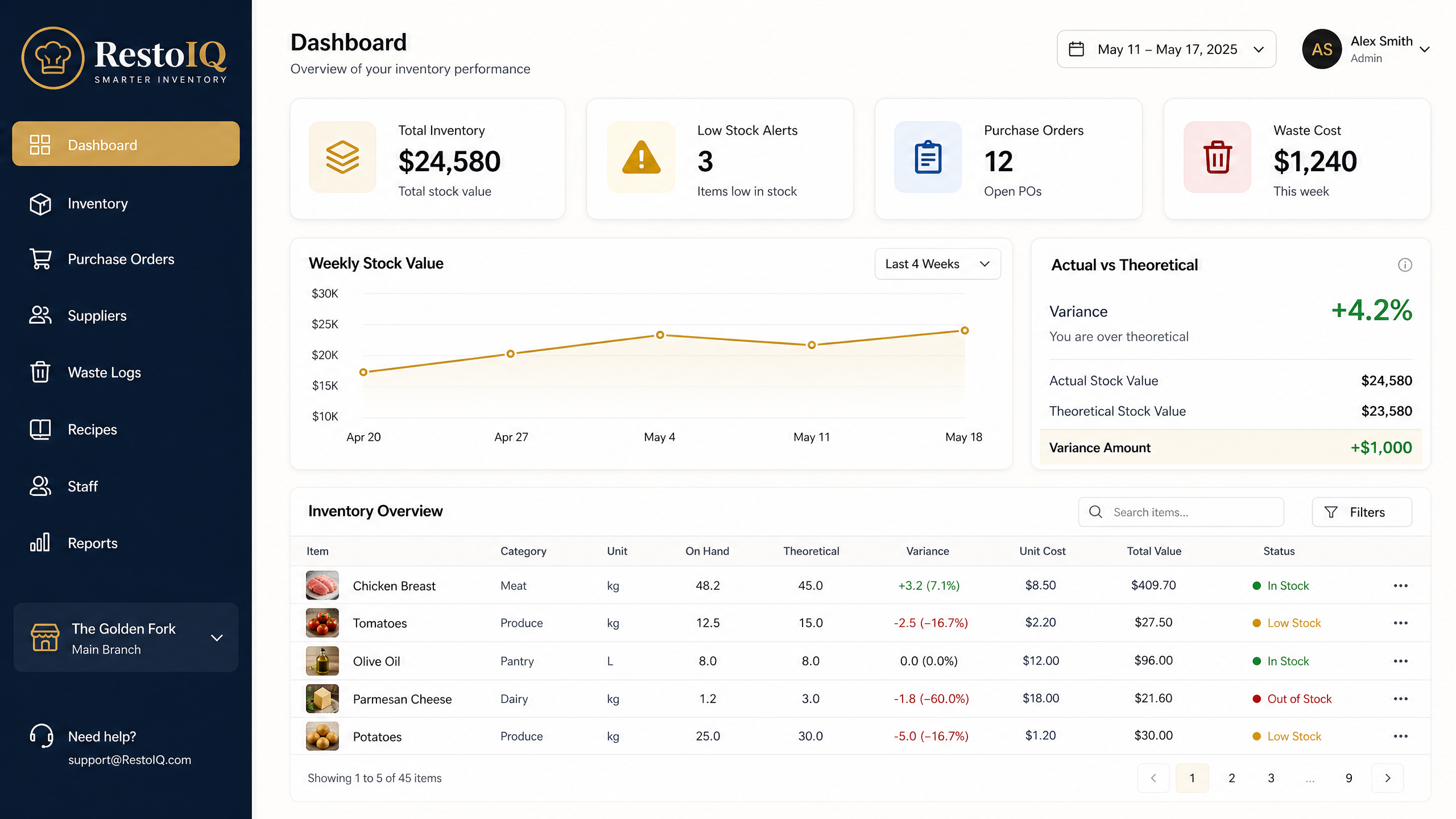
At its core, inventory software maintains four things: recipes (what each dish consumes), counts (what you physically have, weekly), purchases (what came in and what it cost), and waste logs (what left without selling). From those four inputs it computes the numbers that matter: food cost percentage, usage per item, actual-vs-theoretical variance, par-level alerts, and supplier price history. Everything else — dashboards, reports, multi-location rollups — is presentation layered on those four inputs.
When evaluating any platform, ask: how much effort does each of the four inputs require in my kitchen? If counting takes 30 minutes on a phone versus 3 hours with clipboards, that difference determines whether you still do it in month six.
Any serious platform offers a trial; use it to answer five practical questions in week one: Can I enter my top 10 recipes in under an hour? Can I complete a full stock count on my phone in my actual stockroom? Did it show me my real food cost percentage? Did it flag anything I didn't already know (a price drift, a low par, a variance)? And does the weekly workflow feel sustainable — 1–2 hours total, or a second job?
The platforms that pass all five are rare. Most fail on #2 or #4 — either the counting experience is built for a desktop, or the price assumes a revenue base the buyer does not have.
Three things buyers learn late: first, implementation effort is the real cost — every platform looks identical in the demo and differs enormously in month two, when recipe entry and counting discipline actually begin; second, integrations are often less complete than advertised — 'POS integration' frequently means sales totals, not ingredient-level deduction, so ask specifically what the integration deducts; third, support quality varies by market — a platform whose support hours match your timezone and whose team understands your supplier reality will save you more than a fancier dashboard ever will.
RestoIQ was designed explicitly around these five questions: phone-first counting with offline capability, recipe costing from your actual purchase prices, automatic variance computation, pricing built for Africa and the Middle East rather than US chains, and a standalone-complete system with POS connectors added as customers request them — the same path WISK followed to become the most connected platform in the industry. The 14-day free trial exists precisely to let the five questions be answered in your own kitchen, with your own stock, before you pay anything.
Recipe entry speed (top 10 dishes under an hour), a full phone stock count in your actual stockroom, whether it shows your real food cost, whether it flags anything you didn't know, and whether the weekly workflow is sustainable.
Ask what the integration actually deducts — many 'integrations' sync sales totals only, not ingredient-level consumption. The software should be complete standalone; POS connectors are valuable additions, not prerequisites.
Implementation friction: counting experiences built for desktops, recipe entry that takes weeks, and pricing that assumes chain-scale revenue. The platforms that survive are the ones whose weekly workflow fits a real kitchen in real conditions.